
7 Common Payroll Management Challenges and How to Overcome Them
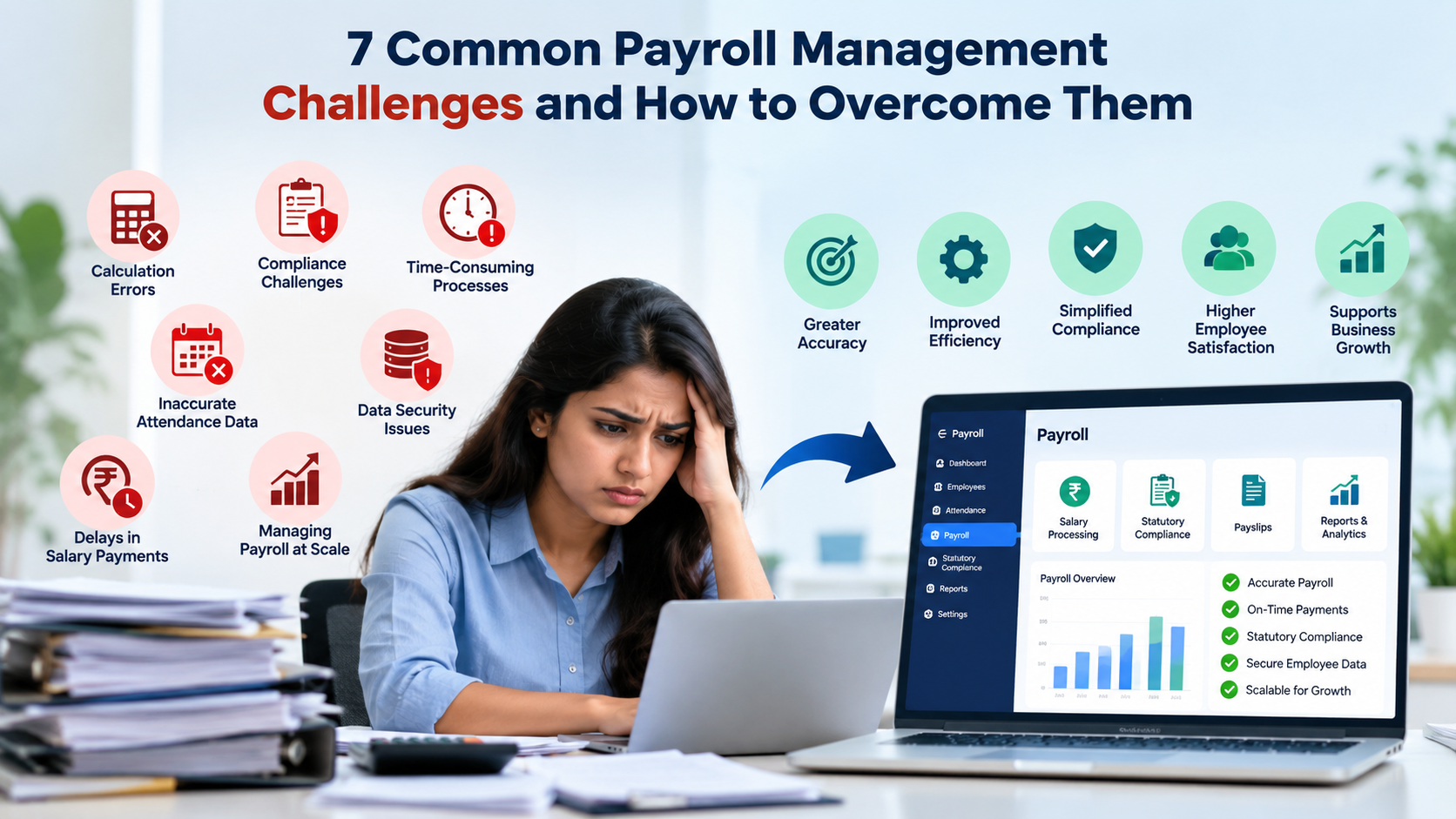
Managing payroll is one of the most important responsibilities for any business. From calculating employee salaries to managing statutory deductions and ensuring timely payments, payroll involves several activities that require accuracy and attention to detail. Even a small mistake can lead to employee dissatisfaction, compliance issues, and unnecessary administrative work.
As businesses grow, handling payroll manually becomes increasingly difficult. This is why many organizations are exploring the top payroll software in India to automate salary calculations, simplify compliance management, and improve payroll accuracy. With the right payroll management system, businesses can reduce repetitive tasks and ensure employees receive their salaries correctly and on time.
However, implementing payroll technology is only one part of the solution. Organizations must also understand common payroll challenges and adopt effective practices to overcome them.
Let's explore seven common payroll management challenges and practical ways to address them.
1. Errors in Salary Calculations
Salary calculation errors are among the most common challenges businesses face during payroll processing. These mistakes can occur due to incorrect attendance records, overtime calculations, leave deductions, incentives, or manual data entry.
For organizations managing hundreds of employees, even minor errors can create significant administrative problems.
Common causes of salary calculation errors include:
-
Incorrect employee attendance records
-
Errors in overtime and leave calculations
-
Outdated salary structures
-
Manual data entry mistakes
-
Incorrect deductions or reimbursements
How to Overcome This Challenge
Businesses should adopt automated payroll software that calculates salaries based on predefined salary structures, attendance records, and payroll policies.
Integrating payroll with attendance and leave management systems can further reduce discrepancies by ensuring that payroll calculations use accurate employee data.
Regular payroll audits and validation checks before salary processing can also help identify potential errors.
2. Managing Statutory Compliance
Payroll compliance is particularly challenging for Indian businesses because employers must consider multiple statutory requirements, including Provident Fund (PF), Employees' State Insurance (ESI), Professional Tax (PT), Tax Deducted at Source (TDS), and other applicable labour regulations.
These requirements may vary depending on employee eligibility, salary structure, business location, and changes in government regulations.
Failure to comply with applicable requirements can result in penalties, additional administrative work, and legal complications.
How to Overcome This Challenge
Organizations should establish a structured payroll compliance process and regularly review applicable statutory requirements.
Using payroll management software with configurable statutory calculations can help businesses manage deductions and maintain payroll records.
However, businesses should also verify that their payroll system reflects the latest applicable regulations, contribution limits, and tax rules.
Periodic compliance reviews and consultation with qualified payroll or tax professionals can further reduce compliance risks.
3. Time-Consuming Manual Payroll Processing
Manual payroll processing requires HR and finance teams to collect attendance records, calculate salaries, verify deductions, prepare payslips, and coordinate salary payments.
When these activities depend heavily on spreadsheets and manual calculations, payroll processing can consume several working days every month.
As employee numbers increase, the workload becomes even more difficult to manage.
How to Overcome This Challenge
Payroll automation can significantly reduce the time spent on repetitive administrative activities.
An automated payroll management system can help organizations:
-
Calculate employee salaries using predefined rules
-
Import attendance and leave information
-
Process allowances and deductions
-
Generate employee payslips
-
Prepare payroll reports
-
Maintain historical payroll records
By automating routine tasks, HR professionals can spend more time on employee engagement, workforce planning, and other strategic responsibilities.
4. Inaccurate Attendance and Leave Data
Attendance and leave records directly influence employee salary calculations. Missing attendance entries, incorrect shift timings, unapproved leave requests, and overtime discrepancies can create payroll complications.
For businesses operating across multiple shifts or locations, managing attendance information becomes even more challenging.
When attendance and payroll systems operate independently, HR teams may need to transfer data manually, increasing the possibility of errors.
How to Overcome This Challenge
Integrating attendance management with payroll software helps maintain consistency between employee working hours and salary calculations.
Businesses should establish clear policies for attendance regularization, overtime approval, paid leave, and unpaid leave.
Managers should also review and approve attendance discrepancies before the monthly payroll cutoff.
A centralized HRMS platform can make it easier to maintain accurate attendance records and minimize manual intervention during payroll processing.
5. Maintaining Employee Data Accuracy and Security
Payroll systems contain sensitive employee information, including bank account details, salary structures, tax information, and personal identification records.
Maintaining accurate and secure employee data is essential for smooth payroll operations.
Outdated employee information can lead to incorrect salary payments, while inadequate security controls may expose confidential payroll records to unauthorized access.
How to Overcome This Challenge
Organizations should maintain a centralized employee database with appropriate access controls.
Role-based permissions can help ensure that only authorized HR and finance personnel can access sensitive payroll information.
Businesses should also implement security practices such as:
-
Multi-factor authentication where supported
-
Encryption of sensitive information
-
Regular employee data verification
-
Audit logs for important payroll changes
-
Secure data backups
-
Timely removal of access for departing employees
Employee self-service portals can also help employees review and update permitted personal information, subject to appropriate verification and approval processes.
6. Delays in Payroll Processing and Salary Payments
Timely salary payments are essential for maintaining employee trust and satisfaction.
However, payroll delays may occur because of incomplete attendance records, pending approvals, incorrect employee details, or last-minute salary adjustments.
These issues become more serious when organizations do not follow a structured monthly payroll schedule.
Repeated salary delays can negatively affect employee morale and create unnecessary pressure on HR teams.
How to Overcome This Challenge
Businesses should establish a clear payroll processing calendar with defined deadlines for attendance updates, leave approvals, salary adjustments, and final payroll verification.
HR and finance teams should coordinate regularly to ensure that all necessary information is available before processing begins.
Payroll software can support this process through automated calculations, centralized records, approval workflows, and payroll reports.
Organizations should also maintain sufficient time for reviewing salary calculations and completing bank payment procedures before the scheduled payday.
7. Difficulty Managing Payroll as the Business Grows
Payroll requirements become more complex as businesses expand their workforce, establish new branches, or introduce different salary structures.
A payroll process that works for 20 employees may become inefficient when the organization grows to 200 or 2,000 employees.
Managing multiple departments, employee categories, locations, and payroll policies through spreadsheets can create operational challenges.
How to Overcome This Challenge
Businesses should choose scalable payroll management software that can support changing workforce requirements.
A suitable payroll system should offer features such as:
-
Configurable salary structures
-
Multiple employee categories
-
Location-specific payroll settings
-
Integration with attendance and leave management
-
Payroll reporting and analytics
-
Employee self-service capabilities
-
Support for statutory compliance requirements
Before selecting software, organizations should evaluate their current payroll needs, future expansion plans, integration requirements, and implementation support.
Choosing a flexible payroll solution can help businesses manage growth without continuously redesigning their payroll processes.
How Payroll Software Helps Businesses Overcome These Challenges
Modern payroll software helps organizations simplify payroll operations by bringing employee information, salary calculations, attendance records, and payroll reports into a more structured system.
Instead of relying on disconnected spreadsheets and manual processes, businesses can use payroll technology to improve consistency and reduce administrative workload.
Some of the key benefits include:
Improved accuracy: Automated calculations help minimize common manual errors in salary processing.
Better efficiency: HR teams can complete routine payroll activities with less repetitive work.
Simplified compliance management: Configurable statutory calculations and reports can support compliance-related activities.
Greater transparency: Employees can access payslips and relevant salary information through self-service portals.
Improved data management: Centralized records make payroll information easier to maintain and retrieve.
Scalability: Businesses can manage increasing employee numbers and more complex payroll requirements without depending entirely on manual processes.
However, successful payroll automation also requires accurate employee data, properly configured payroll policies, regular system reviews, and appropriate internal controls.
Conclusion
Payroll management involves much more than calculating employee salaries. Businesses must also maintain accurate records, follow applicable statutory requirements, protect confidential employee information, and ensure timely salary payments.
Challenges such as calculation errors, compliance complexities, inaccurate attendance records, and manual processing can affect both operational efficiency and employee satisfaction.
By establishing clear payroll policies, improving coordination between HR and finance teams, and adopting suitable payroll management software, organizations can overcome many of these difficulties.
Ultimately, an effective payroll process helps businesses reduce administrative burdens, maintain employee trust, and build a stronger foundation for sustainable growth.

 English
 Arabic
 Spanish
 Portuguese
 Deutsch
 Turkish
 Dutch
 Italiano
 Russian
 Romaian
 Portuguese (Brazil)
 Greek